Free Training
Please complete the form below to book your place on one of our free trial classes. You will get an email confirmation of your place, subject to availability.


Through Wing Tsun, I have found very credible answers to the many kata I learnt before – and much more. The applications are not simply chin na in disguise, nor any nerve-point striking arts, as some suggest. These are ancient secret concepts, and you simply cannot reverse-engineer the meaning without the one-to-one coaching by an experienced Wing Tsun teacher. The difference with having access to the definite answers, is that the training doesn’t stop at conceptual understanding – it expands with context, defences and variations. You no longer train; you become Wing Tsun.
Ng Mui was both a genius and a reformer, condensing knowledge into four empty-hand forms – if you also count the wooden dummy form.
Mobility vs. stability, and the “sitting duck” problem
Wing Tsun teaches a systematic footwork adapted to real fighting environments – tight spaces and multiple threats. Contrary to some social-media masters often portraying Wing Chun as a rooting cult. It is not built upon static “fortress stances” which turns you into a sitting duck (easy to shoot).
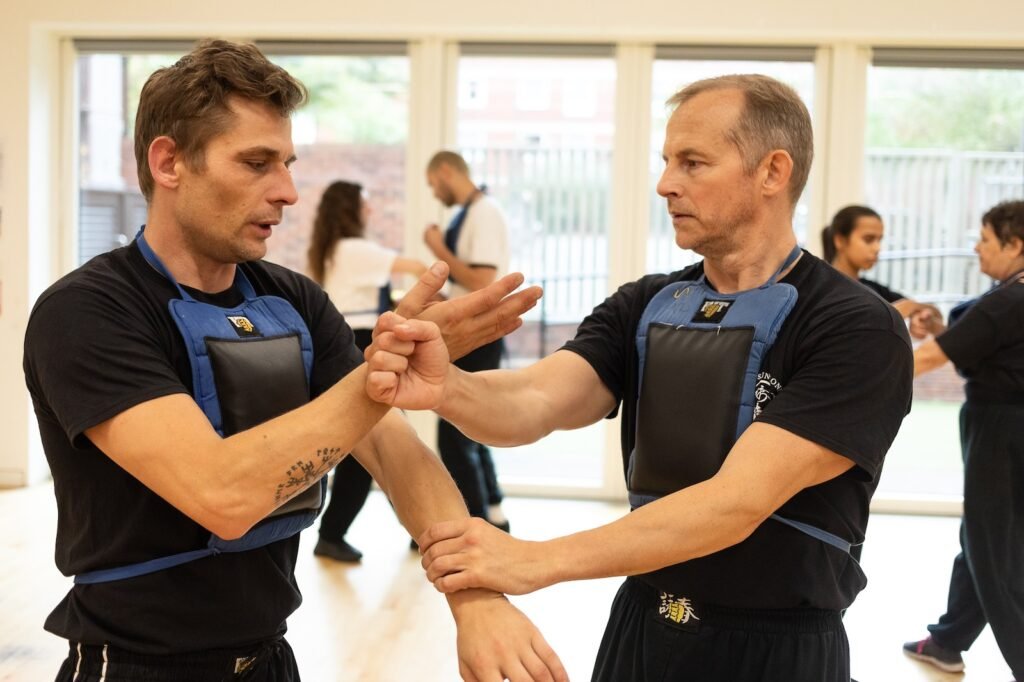
In my experience, Wing Tsun prioritises mobility first: short, efficient steps; controlled transitions; precise angles; and the ability to advance, cut off, and intercept without sacrificing structure. Stability is used momentarily – to generate force, to take advantage of the incoming energy, to redirect – then borrow to return the force. Wing Tsun footwork is the delivery system that lets the hands do their job without turning your base into a fixed target.
Sensory reaction over eyesight
Once you establish a bridge – contact that yields reliable tactile data – the reaction time changes. Vision is fast but can be deceptive. Touch, when trained, is often cleaner: information arrives through pressure, direction, and timing with less delay and less guesswork.
Other systems may contain sensory drills – Filipino martial arts are a clear example. With a history of Chinese sailors passing by the Philippines, Wing Tsun maintains the original, holistic logic for many FMA drills. It connects those drills to a wider defensive logic, including counters, re-counters, and continuation pathways. It is a reactionary decision logic at close range.
People sometimes talk about “adding Wing Chun to a toolbox”. You can borrow concepts, but the deeper value lies in the genius of its tightly coupled holistic architecture.
Based on just over four years in the system, my estimate is that two-thirds to three-quarters of Wing Tsun – the nucleus – functions like a precise jigsaw mechanism, with optimally performed movements that are incompatible with non-Wing Tsun concepts. Small deviations create vulnerabilities that skilled practitioners can exploit instantly. Timing, alignment, and feedback loops are incredibly precise.
Whether you’re a beginner or a martial arts researcher like myself, I hope this exploration sheds light on why I consider Wing Tsun the path to true mastery. Its precision, interconnectedness, and depth make it a discipline that demands not just practice, but genuine understanding – one that reveals its secrets only to those who are truly committed to its path.
By Si-Hing Kris Karppi
Please complete the form below to book your place on one of our free trial classes. You will get an email confirmation of your place, subject to availability.