Free Training
Please complete the form below to book your place on one of our free trial classes. You will get an email confirmation of your place, subject to availability.


I am writing from the Sijo Leung Ting lineage of Wing Tsun, but through the lens of someone who has trained across multiple martial arts and started researching the “secrets” of martial arts 38 years ago. I am driven to find the truth, and nothing but the truth. When I say Wing Chun, I mean the broader family outside the Wing Tsun lineage.
I will keep this focused on five (5) themes: centreline and chain punching; forms as encoded application; mobility versus stability; sensory reaction; and Wing Tsun as an interconnected system.
I began my studies in Japanese ju-jitsu, then moved through karate, Muay Thai, Filipino martial arts (FMA), Small Circle Jiu-Jitsu, and Kosho Shorei Ryu Kempo (1st Dan), among others. What follows is solely my personal observations and opinions.
Centreline, Wudang neijia, and chain punching
Wing Tsun drew me in because it rigorously treats the centreline as a method of control: occupy the shortest line between you and your opponent, strike through it, and deny them the same corridor for return fire. I had previously encountered the centreline concept in Japanese sword work via Kempo.
Most empty-hand systems struggle to keep that corridor closed because power is commonly produced by large rotational mechanics – hips, torso, spinal axis. Rotations that broadcast openings.
Wing Chun’s origin story often links Ng Mui not only to Shaolin but also to Wudang neijia (internal) methods. From my brief experience training Liuhebafa, I find the idea plausible: the internal force-splitting mechanics generate credible power without “opening the gates” through large rotational swings.
Chain punching is often misunderstood as rolling-punches. In reality, it behaves more like a thrusting jackhammer breaking through the reverberating opponent’s body.
Coming from Japanese and Okinawan-linked arts, I always sought the purpose of kata (Japanese forms), trying to identify credible answers to what the shapes are for.
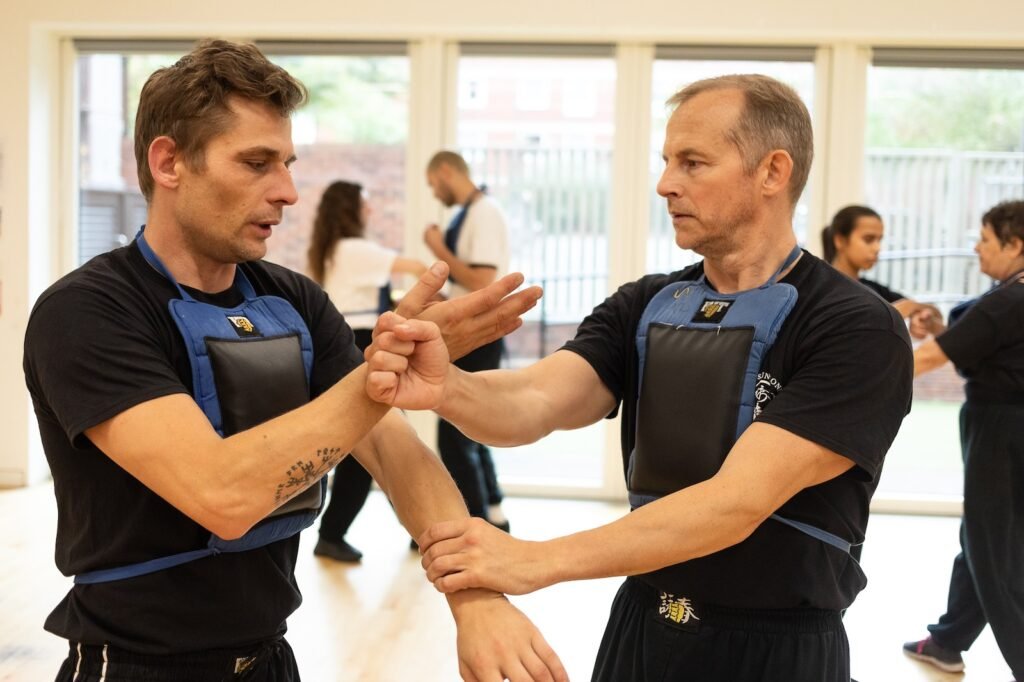
Sijo Leung Ting applied a unique, academically structured approach, organising the Chi Sao training programme to preserve Grandmaster Ip Man’s teachings, which makes the Wing Tsun lineage unique. This knowledge, traditionally passed down through oral tradition, is now organised for clarity. When I started studying and training in Sijo Leung Ting’s Chi Sao program, I found clear answers: forms and applications are mutually dependent, and inseparable. Forms act as a reference library – precise positions, transitions, and constraints. Chi Sao and partnered training supply the operating conditions: pressure, timing, structure, and tactile information.
By Si-Hing Kris Karppi
Please complete the form below to book your place on one of our free trial classes. You will get an email confirmation of your place, subject to availability.