Free Training
Please complete the form below to book your place on one of our free trial classes. You will get an email confirmation of your place, subject to availability.


“When you drink the water, you should always remember the river that has come from the mountain.”
Grandmaster Ip Man
The season of ancestor veneration is around the corner, and it feels like the perfect time to remember Ng Mui, one of the legendary Five Elders who escaped the destruction of the Shaolin Monastery about 300 years ago. Ng Mui was a Buddhist nun, a highly skilled martial artist, and is credited as the founder of Wing Tsun Kung Fu.
Before diving into her story, I’d like to share a few thoughts on ancestor veneration in Chinese culture — a beautiful and deeply meaningful tradition that continues to inspire me.
Ancestor veneration is an ancient practice whose origins fade into the mists of time. It remains one of the cornerstones of Confucian philosophy and everyday Chinese life. In many homes, you’ll find altars or cabinets dedicated to ancestors who are believed to guide and protect their descendants. These altars often include spirit tablets, photos of the departed, incense, and offerings of food.
Among these elements, spirit tablets are perhaps the most fascinating. Usually made of wood, stone, or even paper, each tablet bears the name of an ancestor. It is believed that the spirit of the deceased resides within it — transforming it from a simple object into a sacred bridge between generations.
Now, let’s return to the story of Ng Mui and the birth of Wing Tsun.
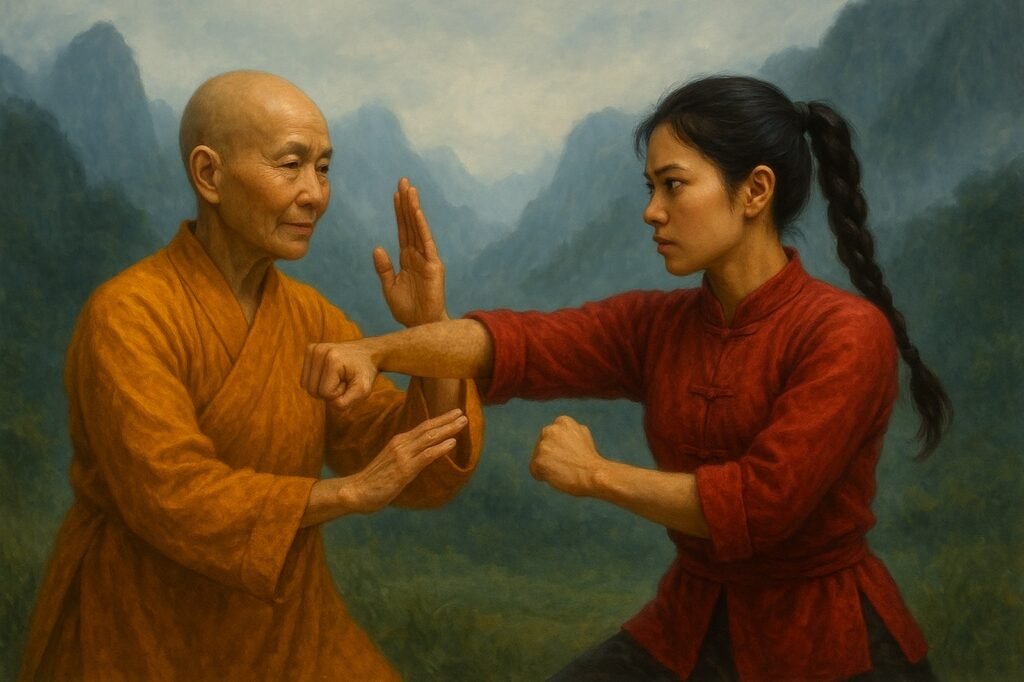
After escaping the burning Shaolin Monastery, Ng Mui took refuge at the White Crane Temple, somewhere between Yunnan and Sichuan. There, she continued to refine her martial arts and share her knowledge.
In a nearby village lived a man named Yim Yee, who ran a small shop with his daughter, Yim Wing Tsun. Wing Tsun was known for her beauty and intelligence — qualities that, unfortunately, drew the attention of a local bully who tried to force her into marriage. Desperate and unsure how to protect herself, she found an unexpected ally in Ng Mui, a regular visitor to her father’s shop.
Moved by the young woman’s situation, Ng Mui offered to teach her kung fu. Wing Tsun accepted and she trained tirelessly for a year under her guidance. When she returned home, Wing Tsun challenged her tormentor and defeated him, earning both her freedom and the right to marry her fiancé, Leung Bok Chau.
To honor her brave student, Ng Mui named her new martial art Wing Tsun, meaning “Beautiful Springtime,” after Yim Wing Tsun herself. The name became a lasting tribute to courage, resilience, and renewal.
I’ve always loved this story because it carries a timeless lesson about self-responsibility and empowerment. Ng Mui could easily have defeated the bully herself — but instead, she chose the nobler path: to teach Wing Tsun how to stand up for herself. Through that act, she passed on something far more powerful than protection — she passed on strength, wisdom, and freedom.
So this month, during the season of ancestor veneration, I invite you to take a moment to honour Ng Mui, who gave us the art of Wing Tsun. You might place her image in your training space or simply write her name on a small piece of paper as an act of remembrance.
May her spirit continue to guide and inspire you in your practice.
By Alice Pordenon , 5th Student Level
Please complete the form below to book your place on one of our free trial classes. You will get an email confirmation of your place, subject to availability.