Free Training
Please complete the form below to book your place on one of our free trial classes. You will get an email confirmation of your place, subject to availability.


Why does it matter to learn Chinese language and culture when studying Wing Tsun apart from just keeping it original?
Traditional Chinese writing is often used in traditional calligraphy, art, and literature. Chinese view it’s traditional characters as a formation evolved with Chinese history, aesthetics, and philosophy from ancient to modern days.
The traditional writing was created dated back more than 3,200 years whereas simplified Chinese is about 60 to 70 years old now. The traditional writing is the official script only used in Hong Kong, Macau and Taiwan.
Cantonese (Yue) has evolved differently than mandarin, Yue is a linguistic descendant that preserved more of old Chinese (Wen Yan) – phonology and vocabulary.
Therefore, the legendary martial artist Ng Mui was born in 1703 during Qing dynasty before China was formed as a country.
Wing Tsun continued to flourish as a southern Chinese martial art through Ip Man when he moved to Hong Kong.
Growing up in Hong Kong, where Cantonese language is spoken and traditional characters are used, I never really thought much about this connection when I was younger. But after settling down here in a different country, I have always been missing home deeply not just the place but the culture and way of thinking from the people as well. However it doesn’t hurt to see differences to exist at all.
When Si-Hing Matt invited me to the opening class of Wing Tsun in Swanley,I thought “Wing Tsun cool, I thought about it before.. why not?”
The moment I stepped into the Wing Tsun London class led by Si-Fu, everything suddenly felt familiar. His movements were graceful in peace and beautiful, the atmosphere felt like home I could understand all the Chinese terms being used in class straight away.
Because of my work schedule, I sometimes visit different schools on different days. Seeing Si-Hing Gabor learning how to write Chinese is always touching—it shows a humble sincere passion for the culture. Even though I live far from Hong Kong, the classes make me feel like I’m right back where I belong, whether I’m in Swanley, Victoria, Old Street, or Camden.
Learning Wing Tsun has helped me reconnect with my Chinese heritage. The traditional gestures, the hierarchy of respect just like in a Chinese family would behave, all honour my culture in every way. This community feels like home: we care for each other as family, passing knowledge from generation to generation.
My fate with Wing Tsun actually began in 2013, in my teenage years, when I visited the Bruce Lee Museum shortly after it opened. What fascinated me most was Bruce Lee’s notebook. His sketches of movements and attacks that looked alive, the crosses and centre lines he drew on faceless figures, the transitions from point A to point B sparked a curiosity in me about martial arts that has never faded.
Those sketches reflected fundamentals, but the deeper I go, especially now reaching the third form, the more I realise how complex and profound Wing Tsun truly is. When Si-Kung held a seminar in London, he explained everything with such depth— depicted the third form, Biu Tze like Chinese calligraphy. He was writing in the old Chinese form showing the Biu Tze movements how they would connect. From that moment, my perspective shifted: Wing Tsun is cultural and also mathematical, just as Si-Kung once described.
“A good beginning is half the success.”
To build a strong foundation and progress step by step, we must honour the fundamentals and the culture from where they come from.
Your feet are the roots of a tree, gripping the ground. Your body becomes a system of levers. With leverage, you minimise energy use, exchange force for speed and balance, and generate power like a spring. The body becomes a unified mass, producing force through acceleration. The art whispers these messages through the body while practicing it when you are relaxed and allow it to present in you.
And to master this you have to find peace and balance within yourself and reconnect.
Every seminar passes like a family gathering, short and sweet. Each time I meet Si-Kung, I feel more connected to him, especially when he says, “Yum cha.” That brought me straight back to good old memories sitting in a dim sum restaurant and I imagined he had the same with the Wing Tsun family.
His way of thinking reflects traditional Chinese culture. He often explains the meanings behind Chinese words, shares stories from China, or recalls conversations and time with his Sifu, Leung Ting. Si Kung’s passion is unstoppable. The same passion shines through Si-Fu and our Si-Hings. It reminds me that the picture is always bigger than ourselves.
I am truly grateful for our Wing Tsun lineage, which preserves the traditional art passed down from Yip Man without mixing in other martial arts or concepts. This shows deep respect for our masters and Wing Tsun the art itself. Nothing is stolen, nothing diluted—only preserved with integrity. And through all the evidence and teachings, it becomes a clarity that our lineage carries an incredibly rich and profound understanding of Wing Tsun.
Today, the art continues to flourish across the world—and I am thankful to be part of its journey.
The beautiful ancient cultural and historical martial art of what we preserved will not changed if you could see yourself holding it with respect but it travels far. And it has it’s mission to cultivate the next generation continuously.
By Angela Poon , 1st Master Level
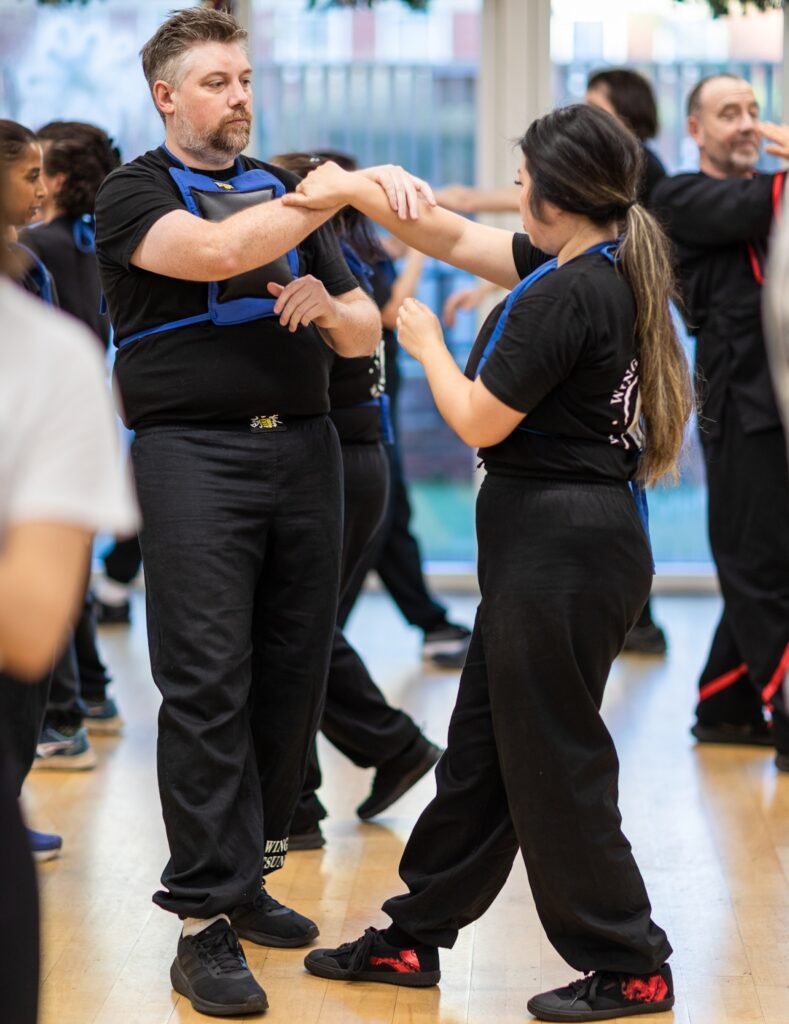
Please complete the form below to book your place on one of our free trial classes. You will get an email confirmation of your place, subject to availability.