Free Training
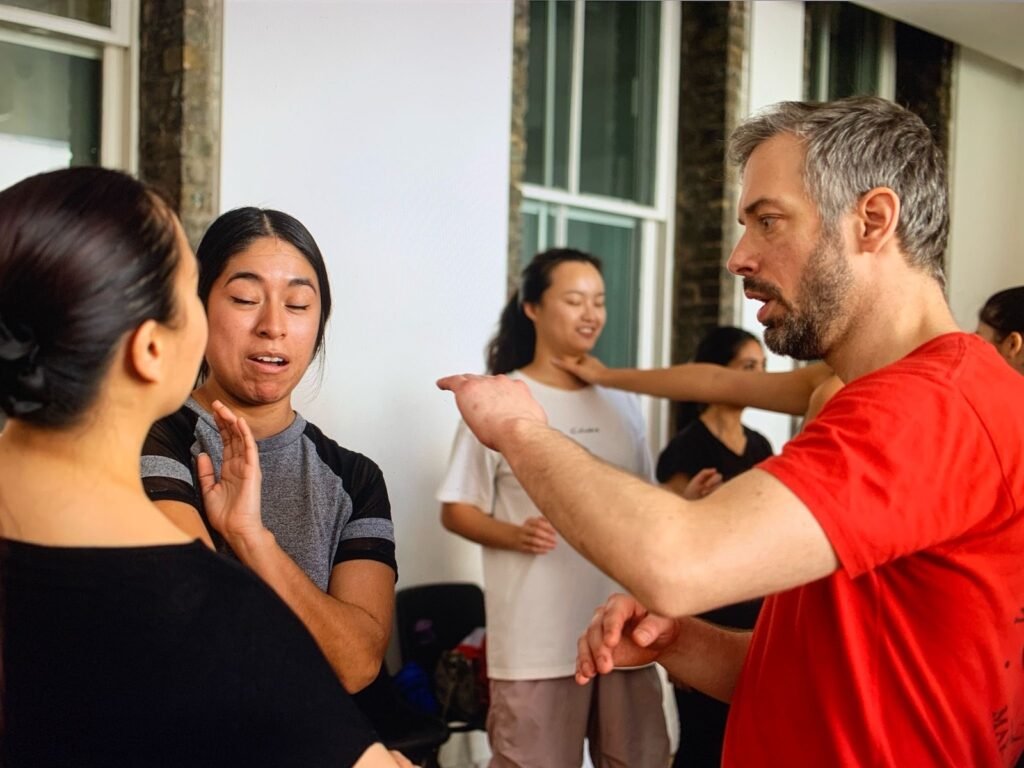
Please complete the form below to book your place on one of our free trial classes. You will get an email confirmation of your place, subject to availability.


I was a kid at a time and place where it was normal for boys to fight from time to time, and my father and grandfather even taught me some useful moves and takedowns. We would watch Bruce Lee, Jackie Chan, Karate Kid, Jean Claude Van Damme, Steven Seagal and all sorts of Chinese martial art movies on VHS with fascination. My grandad loved watching boxing, and my father, even though he did wrestling throughout secondary school, he was more into oriental martial arts. When I was a teenager, he started doing wing tsun. He talked about it with an excitement and enthusiasm, that seemed to be contagious. In my late teens I signed up too, and for a few months practiced with him. Unfortunately, it was around the time I started uni in a different city, and I didn’t continue.
A few years later I moved to London, but it wasn’t until 11 years after my first encounter with wing tsun that I joined SiHing Gabor’s class, becoming one of his first students. In the years in between, I didn’t engage in much physical activity apart from periods of time commuting by bicycle. My mental health wasn’t great, I often felt down and quite hopeless but also physically tired, and had no confidence at all. I believe this came in a large part from a sense of isolation as an immigrant and a lack of guidance and purpose. In 2013, after my best friend’s, SiHing Gabor’s relentless persuasion, I finally picked up wing tsun. My mental health improved. I started feeling healthier, and even though I took part in physically demanding training sessions, I started having more energy in everyday life. I saw the same faces, trained with the same people, which eventually created a sense of belonging. More than that, when you train something like wig tsun where you practice attacking and defending in pairs, there is a certain level of trust that needs to be established between each participant, which in turn creates a bond over time. In a nutshell, I became part of a community of likeminded people, who shared the same goal: learning wing tsun.
A number of years ago, I started becoming increasingly interested in psychology and neuroscience, and found scientific explanation for my experiences of training wing tsun and its positive impact on my life I have described above. Moving the body on a regular basis improves not only the health of the body but also the brain, and consequently mental health. Being part of a community (in a meaningful sense) is extremely beneficial to the individual.
A lot of the benefits I mentioned can be experienced through practicing any martial art I believe, and I have deep respect for anyone who practices any style in a serious manner. Wing tsun however, has a unique set of qualities that sets it apart from others. Apart from its obvious effectiveness in close range combat that makes it a go to martial art for many armed forces around the world, and its ingenious techniques that earned it the title ‘martial art of the intelligent person’, it has a perhaps less obvious appeal that becomes more apparent as one familiarises themselves with the historical and philosophical background of the art. When I was younger, all I wanted was to learn was how to fight really well. How to punch, kick, elbow really hard. Eventually I understood that always trying to go forward with force only works until I match the strength of my opponent. When facing a stronger, heavier opponent, turning, yielding, avoiding, not trying to fight force with force become crucial elements of our strategy that allow us to move into more advantageous positions fast as well as preserving energy. These hard and soft aspects of wing tsun echo perfectly the black and white shapes of the Yin and Yang symbol.
By Si-Hing Gergely
Please complete the form below to book your place on one of our free trial classes. You will get an email confirmation of your place, subject to availability.